The Guaraní-Chiriguanos and Bolivia’s Bicentennial
DOI:
https://doi.org/10.35319/rcyc.2025551398Abstract
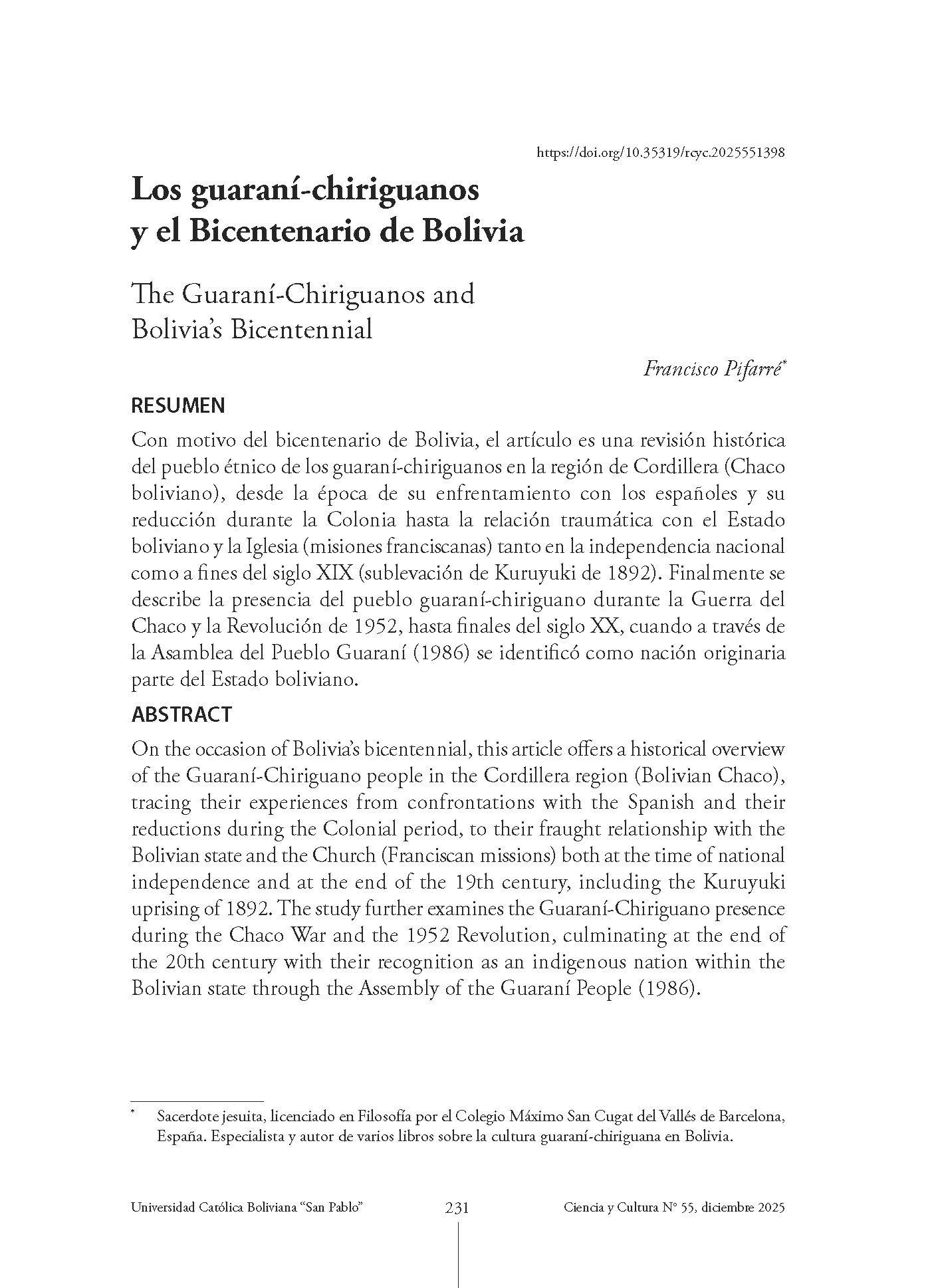
On the occasion of Bolivia’s bicentennial, this article offers a historical overview of the Guaraní-Chiriguano people in the Cordillera region (Bolivian Chaco), tracing their experiences from confrontations with the Spanish and their reductions during the Colonial period, to their fraught relationship with the Bolivian state and the Church (Franciscan missions) both at the time of national independence and at the end of the 19th century, including the Kuruyuki uprising of 1892. The study further examines the Guaraní-Chiriguano presence during the Chaco War and the 1952 Revolution, culminating at the end of the 20th century with their recognition as an indigenous nation within the Bolivian state through the Assembly of the Guaraní People (1986).
Downloads
References
Martarelli, Angélico (1918). El Colegio Franciscano de Potosí y sus misiones. Noticias históricas por el P. Fr…, misionero del mismo Colegio. Potosí: Tipografía Italiana.
Pifarré, Francisco (2015). Historia de un pueblo. Los guaraní-chiriguanos. La Paz: Fundación Xavier Albó y CIPCA.
Sanabria Fernández, Hernando (1972). Apiaguaiqui-Tumpa. Biografía del pueblo chiriguano y de su último caudillo. La Paz: Los Amigos del Libro.
Downloads
Published
How to Cite
Issue
Section
License
Copyright (c) 2025 Revista Ciencia y Cultura

This work is licensed under a Creative Commons Attribution-NonCommercial 4.0 International License.